

Blogs
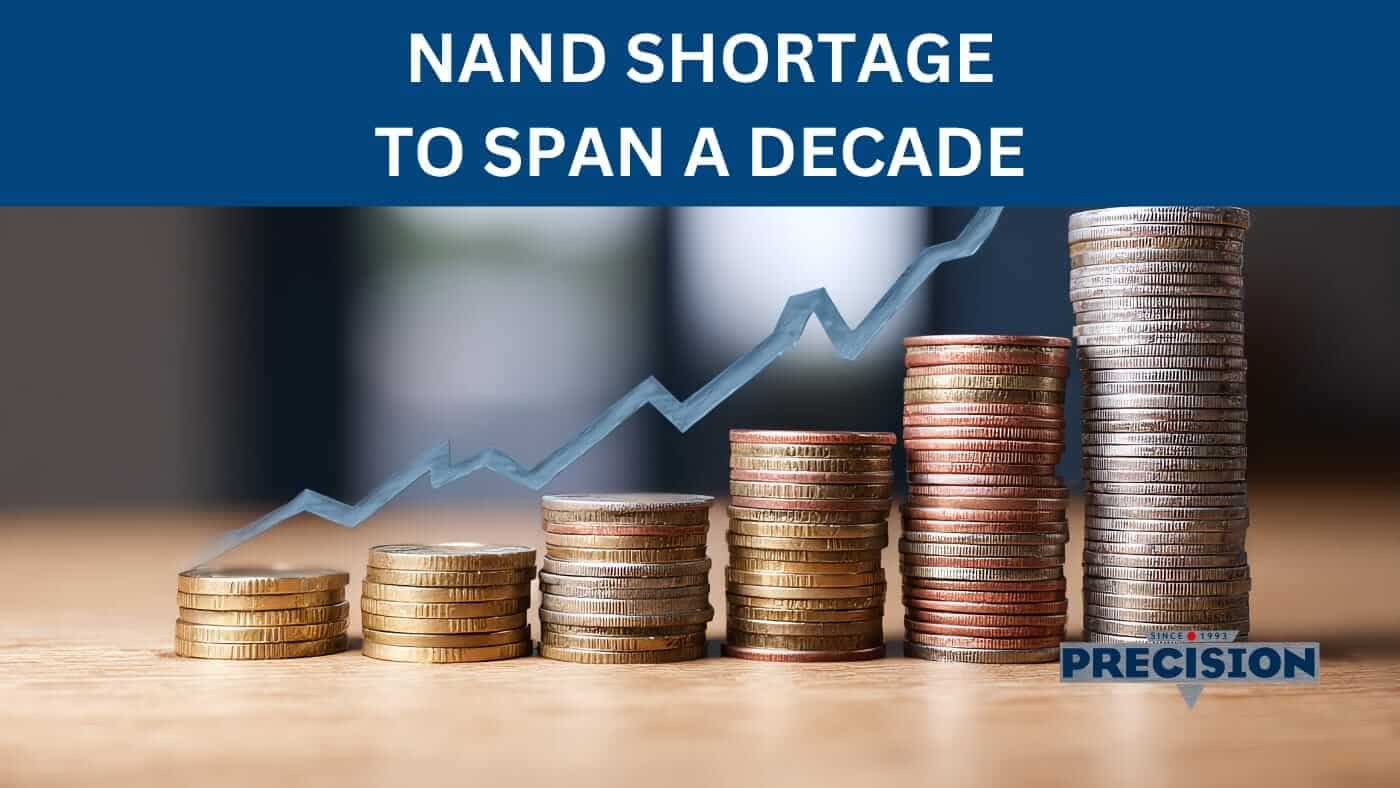
NAND shortage to span a decade: what businesses and consumers need to know
Table of Contents
- What the forecasts and industry leaders are saying
- Why NAND capacity could stay constrained for years
- Immediate effects: prices, lead times and repair economics
- Who feels the pain: consumers, SMBs and data centres
- Practical strategies: procurement, storage architecture and recovery
- Cost-control playbook for IT managers
- A quick comparison table: normal market vs decade-long NAND shortage
- How Precision Computers helps Brisbane customers
- FAQs
The NAND shortage forecast is no longer a passing headline: industry voices are warning that constrained flash supply could last for many years. For anyone who buys SSDs, runs server fleets, plans backups, or relies on data recovery, this is significant—higher SSD costs, longer lead times and more pressure on repair and recovery services are likely. Precision Computers, operating since 1993, helps Brisbane customers plan procurement, choose resilient storage strategies and use local repair and recovery where replacement becomes costly.
What the forecasts and industry leaders are saying
Recent public comments and market reports suggest the market may be entering an extended period of tightening. Executives in the supply chain have suggested worst-case scenarios that see limited NAND bit growth relative to surging demand from AI and hyperscale cloud infrastructure. For example, leadership comments captured by industry press have explicitly warned of a multi-year shortage that could stretch toward a decade.
Market trackers such as TrendForce have already flagged contract price rises and tightened allocations in 2025, with expectations that price pressure could persist into later quarters if demand continues to outpace available bit supply. These signals translate into more expensive SSDs and longer procurement lead times for many buyers.
Meanwhile, major memory vendors are prioritising high-margin products like HBM for AI accelerators. Reports indicate companies like SK Hynix have pre-sold significant capacity into AI programmes, shrinking the pool of wafer starts available for commodity NAND. That combination — rising demand and capital reallocation — is the core reason many analysts now model a multi-year tightness scenario.
Why NAND capacity could stay constrained for years
Three structural factors make this more than a short cycle:
- AI-driven demand: training and inference workloads require vast storage and fast access tiers. Hyperscalers are locking in capacity and prioritising performance tiers.
- Investment focus shift: fabs are directing scarce CAPEX toward HBM and advanced packaging to serve AI accelerators rather than expanding commodity NAND at scale.
- Historical capital discipline: after painful oversupply cycles, flash makers have become conservative about expanding capacity, delaying new lines until returns justify heavy investment. That caution compresses supply growth when demand surges.
Put simply, demand is growing rapidly while the supply-side response is calibrated and gradual — a classic recipe for a prolonged period of relative scarcity.
Immediate effects: prices, lead times and repair economics
If the NAND shortage scenario plays out, expect several near-term consequences:
✅ Rising SSD and flash prices — contract indices and vendor announcements show price increases already appearing in 2025.
✅ Longer lead times — popular capacity points will be allocated first to large buyers, stretching delivery times for smaller orders.
✅ Higher replacement costs — for repair shops and consumers, the replacement part becomes more expensive, shifting economics in favour of data recovery where feasible.
✅ More conservative upgrades — IT teams may delay non-critical upgrades or choose storage tiering strategies to reduce NAND consumption.
For businesses that historically replaced drives by default, the calculus changes: recovering and refurbishing drives may be more cost-effective than wholesale replacement when NAND prices spike.
Who feels the pain: consumers, SMBs and data centres
- Consumers and gamers: retail NVMe and high-capacity SSDs will become pricier, making capacity upgrades less attractive.
- Small and medium businesses: SMBs with modest procurement leverage may face limited stock and higher per-unit costs at times of tightness.
- Enterprises and hyperscalers: while they may secure volume via long-term contracts, their demand further tightens the general market and can crowd out smaller buyers.
Repair centres and recovery specialists may see changed customer behaviour: owners choose data recovery or refurbishment rather than expensive part replacement.
Practical strategies: procurement, storage architecture and recovery
Here are practical, actionable steps to reduce exposure to the NAND shortage:
✅ Audit inventory and forecast demand — map the next 12–36 months of replacements and expansions.
✅ Stagger purchases — plan tranche buying to average out price risk.
✅ Negotiate allocations or long-term supply for critical projects if possible.
✅ Implement storage tiering — keeps hot data on SSD while moving cold archives to HDD or object storage to preserve NAND capacity.
✅ Leverage data recovery when replacement is expensive — recovery can cost less than buying new high-capacity SSDs. (See our Data Recovery service.)
✅ Consider refurbished or enterprise-grade options — certified enterprise drives can offer better longevity for heavy workloads.
✅ Design custom systems with balanced storage — our Custom computers can be optimised for minimal NAND dependence where necessary.
These decisions improve resilience and control costs while still delivering an acceptable user experience.
Cost-control playbook for IT managers
For IT managers, a clear playbook is essential:
- Classify workloads — hot, warm, cold. Move cold data off flash.
- Set procurement policies — approved suppliers, budget windows and staggered buys.
- Prioritise critical systems — allocate the fastest/closest storage only where needed.
- Use data recovery as a tactical tool for failed drives when replacement is costly. (Precision Computers offers data recovery and repair.)
- Run regular capacity planning exercises and model price scenarios.
These steps reduce surprise costs and help maintain operations during sustained market tightness.
A quick comparison table: normal market vs decade-long NAND shortage
Feature | Normal NAND Market | Decade-Long NAND Shortage |
Price stability | Moderate | High volatility and periodic spikes |
Lead times | Short | Extended for popular SKUs |
Upgrade frequency | Regular | More conservative, recovery-focused |
Repair economics | Replace often | Recover/repair becomes attractive |
Procurement strategy | Opportunistic buys | Contracted and staggered buying |
How Precision Computers helps Brisbane customers
Precision Computers supports local customers with practical services designed for constrained supply times:
- Device audits & storage planning — identify where NAND is essential and where alternatives work.
- Data recovery & repair — preserve data and extend device life rather than immediate replacement. (Data Recovery).
- Custom-built systems optimised for tiered storage — reduce reliance on large-capacity NAND if needed. (Custom Built Computers).
- Local repairs and spares management — we manage parts locally and offer repair options to delay costly replacements. (Computer Repairs).
All new systems come with a 3-year warranty and 5 years of technical support, plus free Brisbane metro delivery — helpful when procurement cycles are uncertain.
FAQs
Will SSD prices keep rising because of a NAND shortage?
How long could the NAND shortage last?
Should I delay buying SSDs now?
It depends. For urgent needs or price-sensitive buys, consider buying now or securing a purchase window. For non-urgent upgrades, plan and stagger purchases or consider tiered storage. Consult a supplier for options.
Is data recovery a viable alternative to replacement?
Yes. When replacement costs are high, recovering data from existing drives may be more economical—especially for users with limited budgets. Precision Computers offers professional recovery services.